The species of Languriidae are separated from those of family Erotylidae because the hollows into which the front coxae fit are open to the rear. Several of the genera of Languriidae were formerly placed in family Cryptophagidae, but these are now separated on the basis of the ± complete elytral epipleura, the hind tarsi always being 5-segmented in males but primarily on the basis of the structure of the metendosternite (the base of the metendosternite is located on hind coxae with its free end in the thorax, serving for muscle attachment). In Central Europe the family is represented by a few genera containing single species. The genera are also keyed out in the main family key into the families they were previously assigned.
#1
Zavaljus Reitter, 1880Head with pointed temples behind the eyes (genus Eicolyctus Sahlberg)
→ 2-Head without pointed temples behind the eyes - usually the head is retracted under the pronotum up to the eyes.
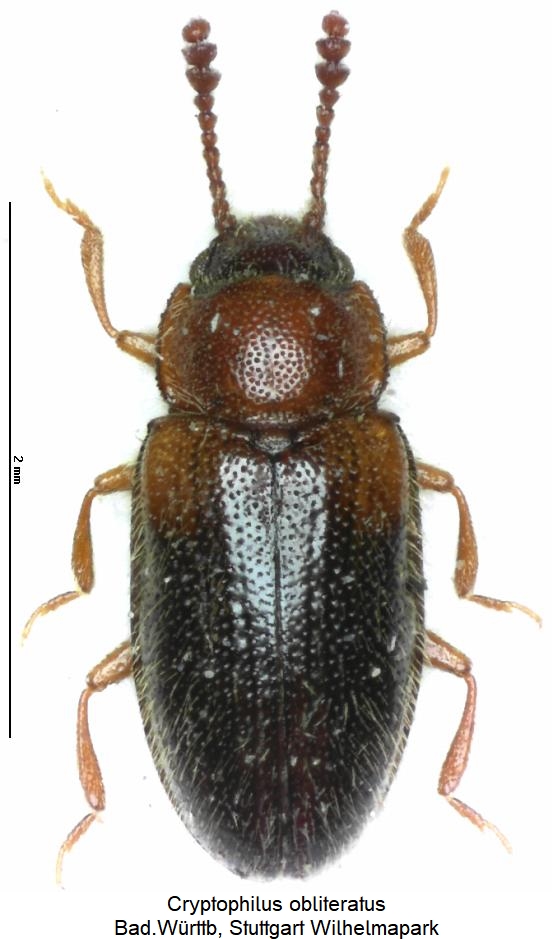
Cryptophilus Reitter, 1874The second and particularly the third segments of the tarsi are elongated into lobes on the underside. Elytra with punctures arranged in clear rows in between the dense punctures [Abb. 1]. Regarded by some authors as a separate family Cryptophilidae
→ 4Upper surface bare or with extremely short and sparse hair. Pronotum with a small longitudinal furrow in front of the base on each side. Elytra with a sinuous border at the base with the punctures arranged in rows.
→ 5-Upper surface very clearly hairy. Pronotum without longitudinal furrows near the base. Elytra without a border at the base; punctures either random or arranged in rows.
Pharaxonotha Reitter, 1875Eyes evenly convex, not projecting. Third segment of the antennae only very slightly longer than the second. Sides of the pronotum with a very strong keel-like border. The intercoxal process of the first visible sternite of the abdomen quite narrowly pointed.
Loberogosmus-Eyes distinctly convex, projecting. Third segment of the antennae much longer than the second. Pronotum with a fine border at the base. The intercoxal process of the first visible sternite of the abdomen is rounded.
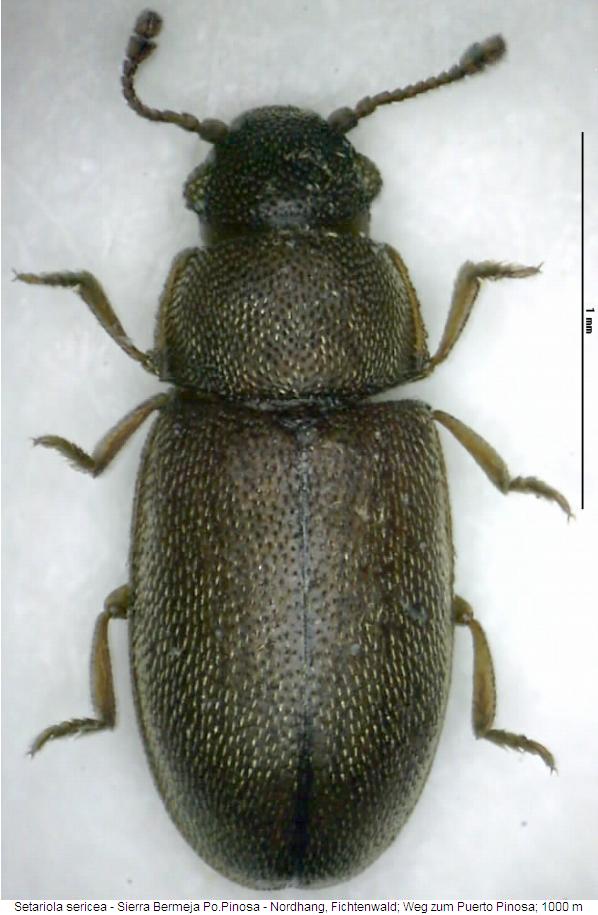
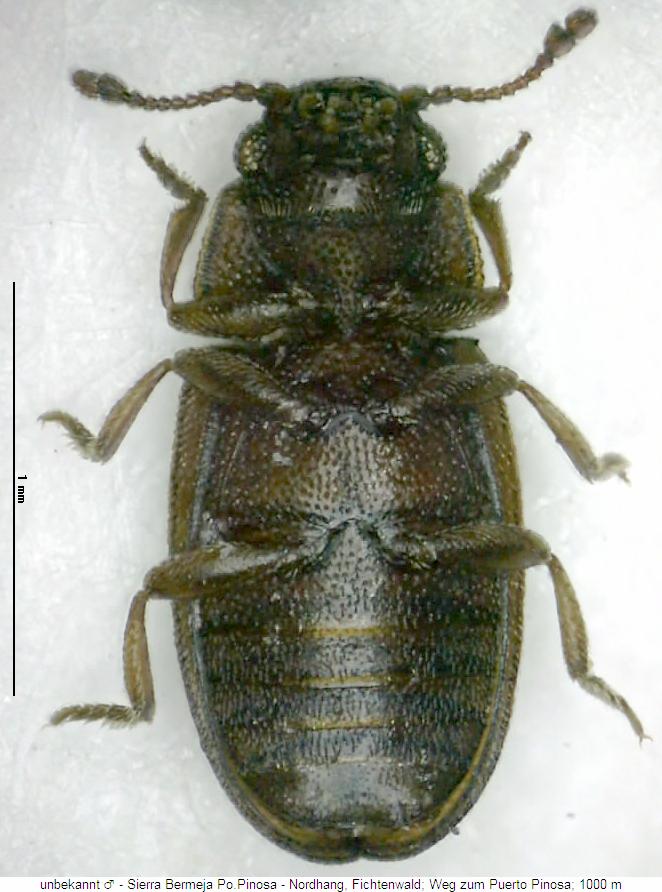
Setariola Jakobson, 1915Antennae with a 2-segmented club. Body short and compact, similar to a species of Cis. Elytra with randomly punctured, without sutural striae [Abb. 2].The front coxae are slightly broader than long [Abb. 3].
Abb. 2Abb. 3
→ 6-Antennae with a 3-segmented club. Body more elongate. The punctures on the elytra are either arranged in rows or randomly; if they are random then there is a distinct sutural stria in the rear half. The front coxae are nearly spherical.
Macrophagus Motschulsky, 1845The front angles of the pronotum are not thickened. The pronotum is broadest in the middle and is roundly narrowed towards the front and rear. The third segment of the 8-segmented antenna is comparatively large. Elytra with random punctures. (Genus Haplolophus)
Leucohimatium Rosenhauer, 1856-The front angles of the pronotum are only weakly thickened. Segments 3-8 of the antennae are slender. The punctures on the elytra are usually arranged in regular rows.
 Käfer Europas herausgegeben von Arved Lompe sind lizenziert unter den Bedingungen der Creative Commons International 4.0 Lizenz BY-SA (Namensnennung-Weitergabe unter gleichen Bedingungen)