Von Arved Lompe (adapted after Y. Bousquet & S. Laplante)
Bousquet, Y. & Laplante, S. (1999): Taxonomic review of the Canadian species of the genus Monotoma Herbst (Coleoptera, Monotomidae) - Proceedings of the Entomological Society of Ontario, 130:67-96 >>>"F:\taxa\coleo\scans\Bousquet&Laplante1999 Monotoma Kanada.pdf"
Key to the species of Monotoma In Canada and adjacent parts of USA
#1
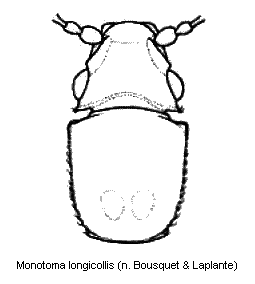
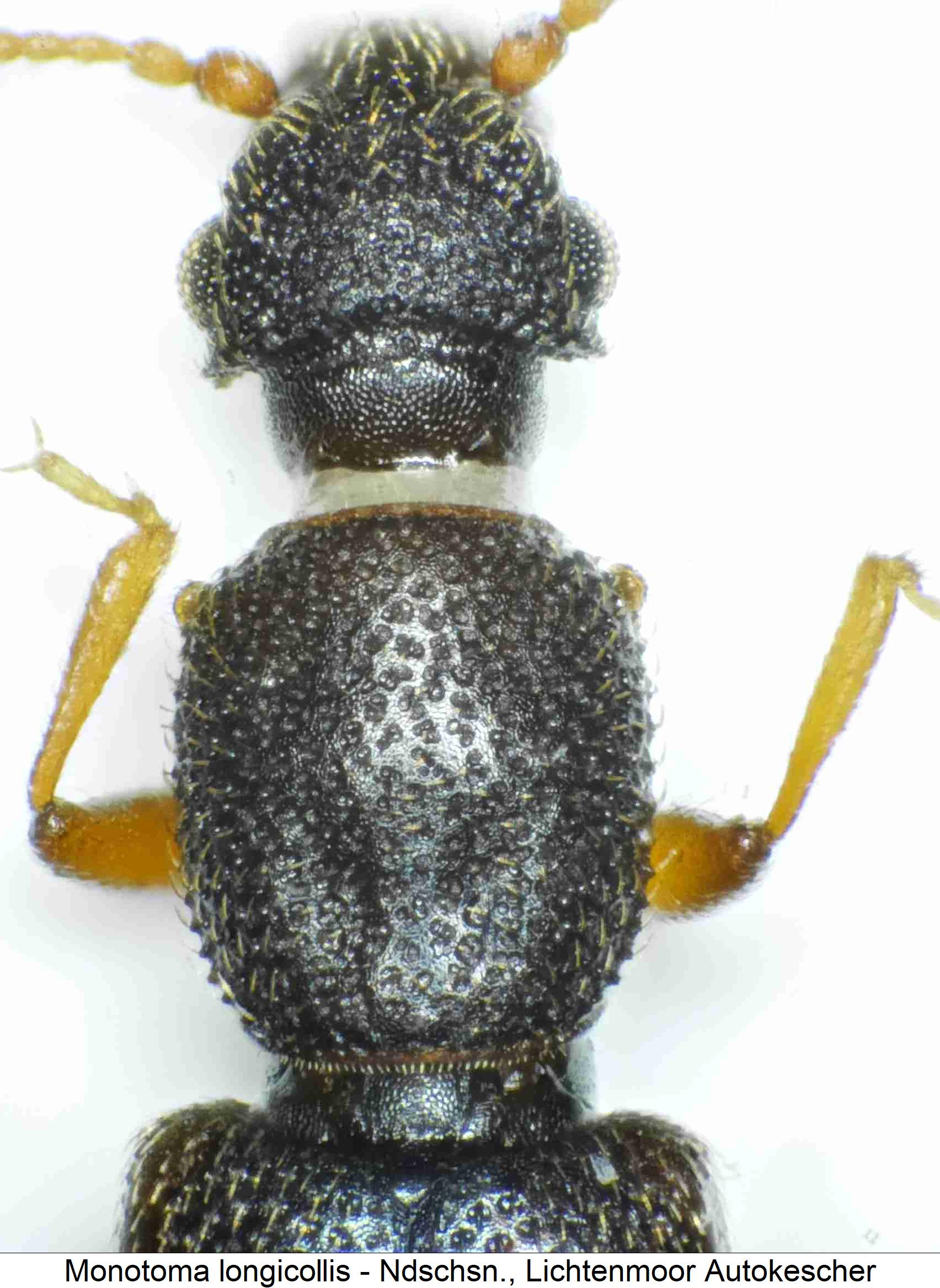
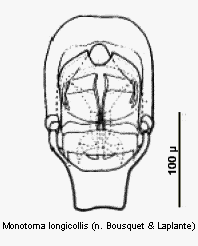
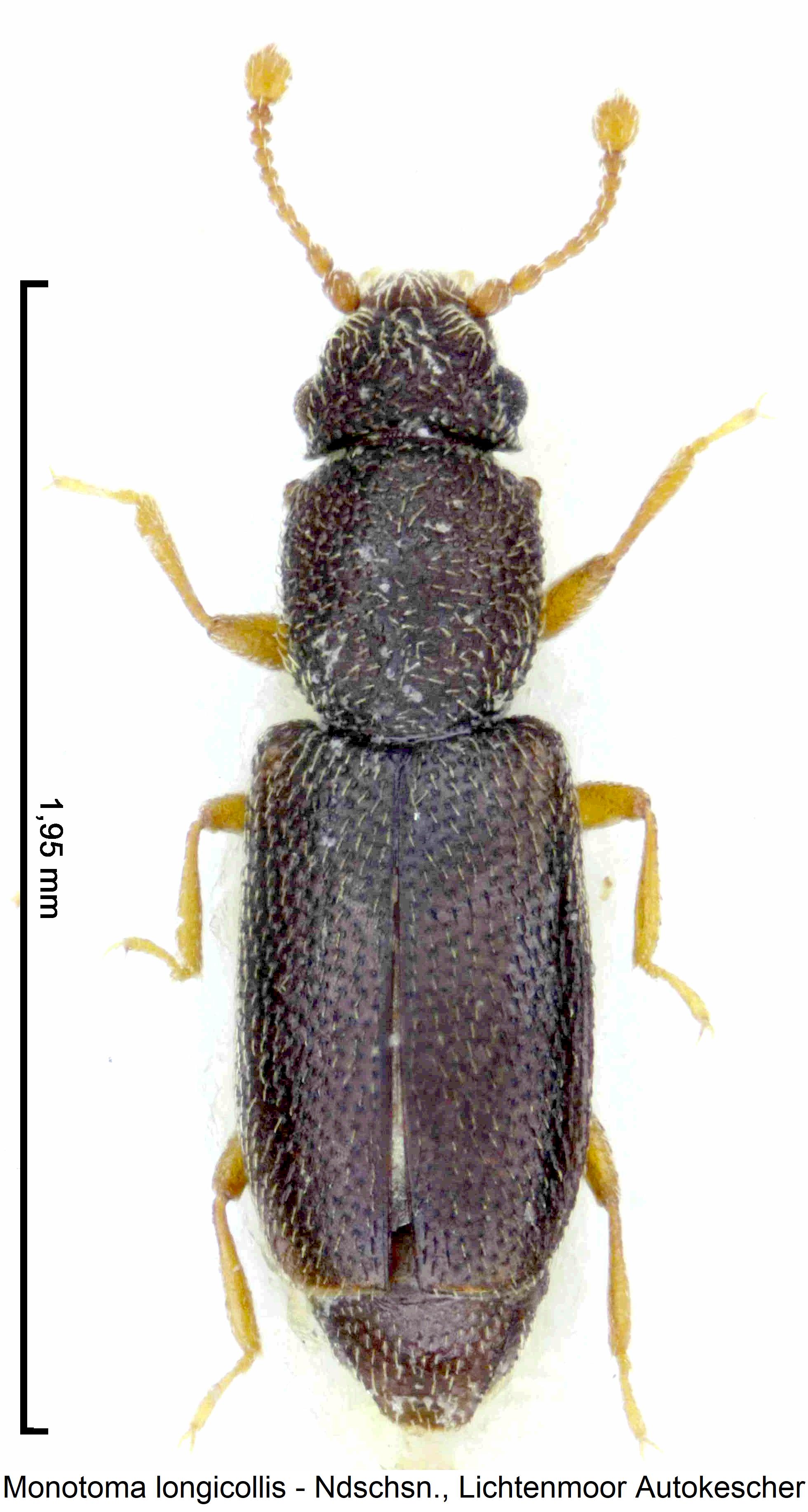
longicollis (Gyll., 1827)🗺Pronotum distinctly wider anteriorly [Abb. 1]. Pronotum with small shallow punctures, irregularly spaced, not contiguous [Abb. 2]. Aedeagus [Abb. 3]. 1.4-1.9 mm. Habitus [Abb. 4]. Europe, Caucasus, Japan, West Africa, Australia, New Zealand and America. The species has been accidentally introduced in North Anterica.
Abb. 1Abb. 2Abb. 3Abb. 4
→ 2-Pronotum more or less parallelsided [Abb. 5] or wider posteriorly [Abb. 6]. Pronotum with large, deep, contiguous or subcontigous punctures.
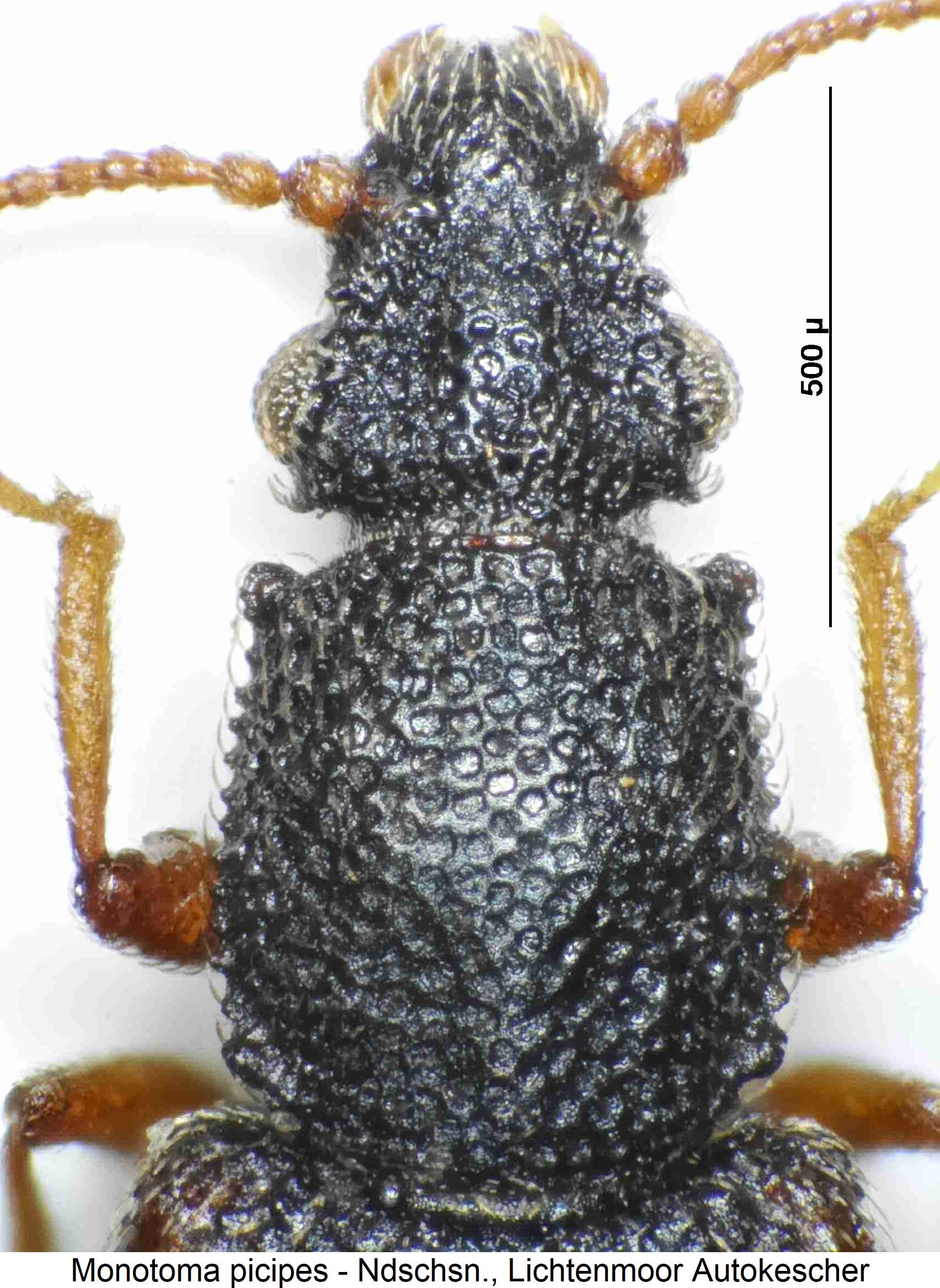
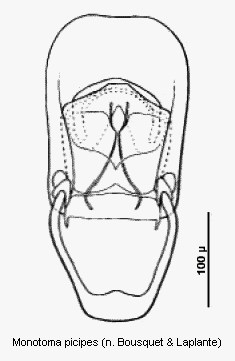
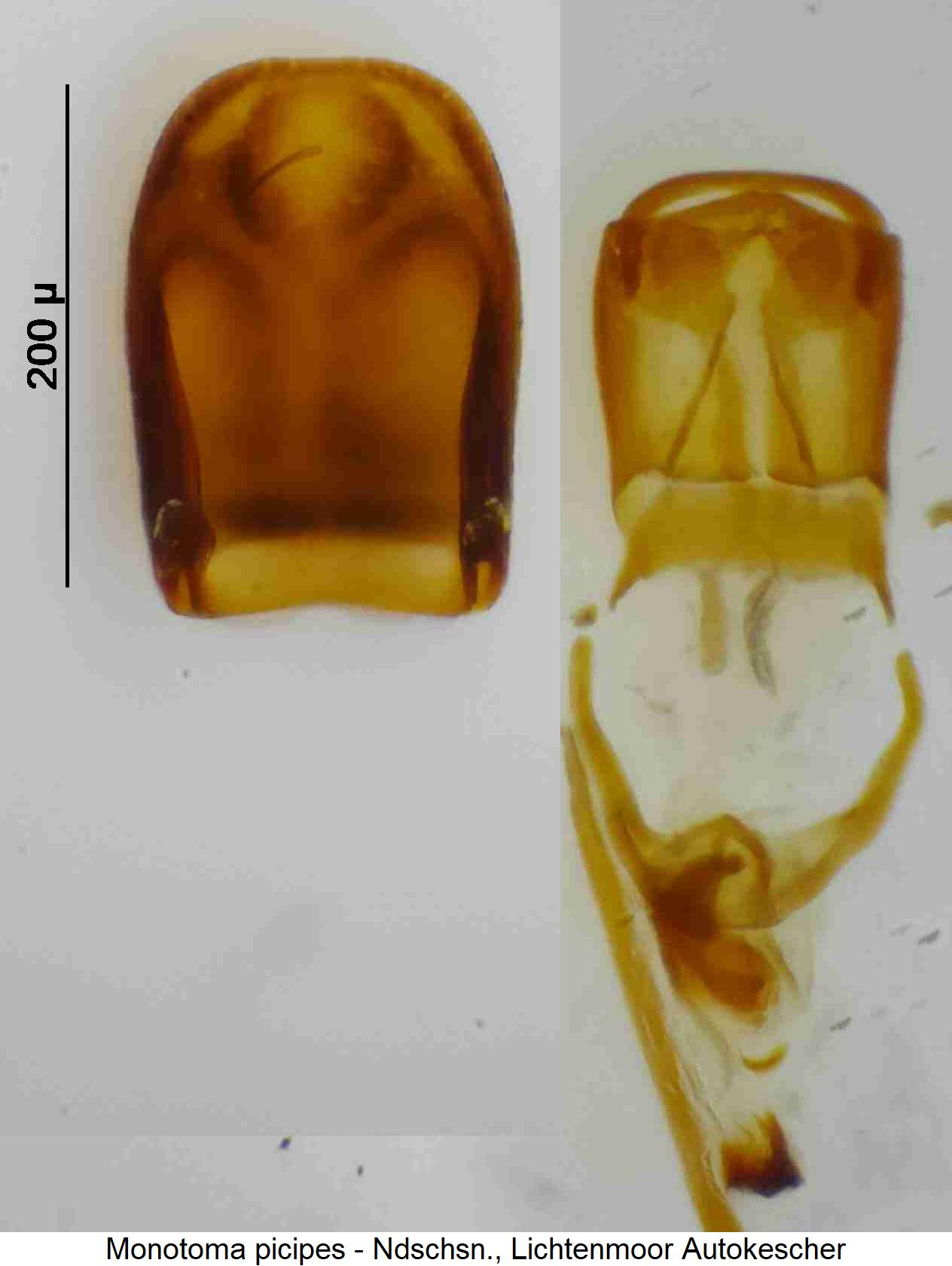
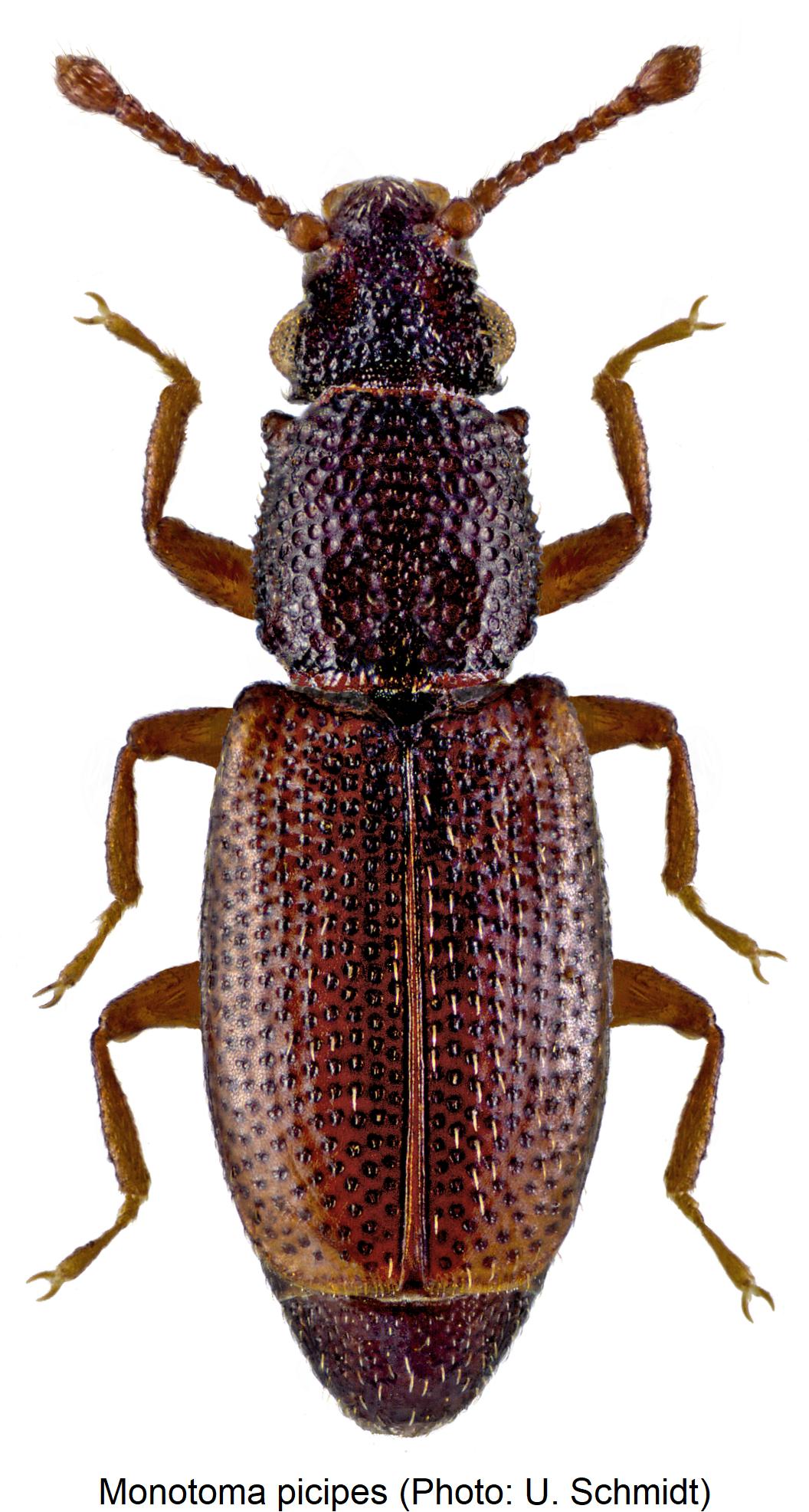
picipes Hbst., 1793🗺Frons with 2 deep, longitudinal impressions [Abb. 7][Abb. 8]. Aedeagus [Abb. 9][Abb. 10]. 1.9-2.5 mm. Habitus [Abb. 11]. This species has been recorded from many countries around the world and is regarded as cosmopolitan.
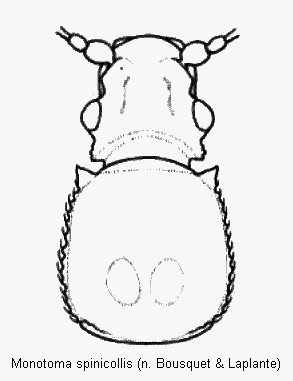
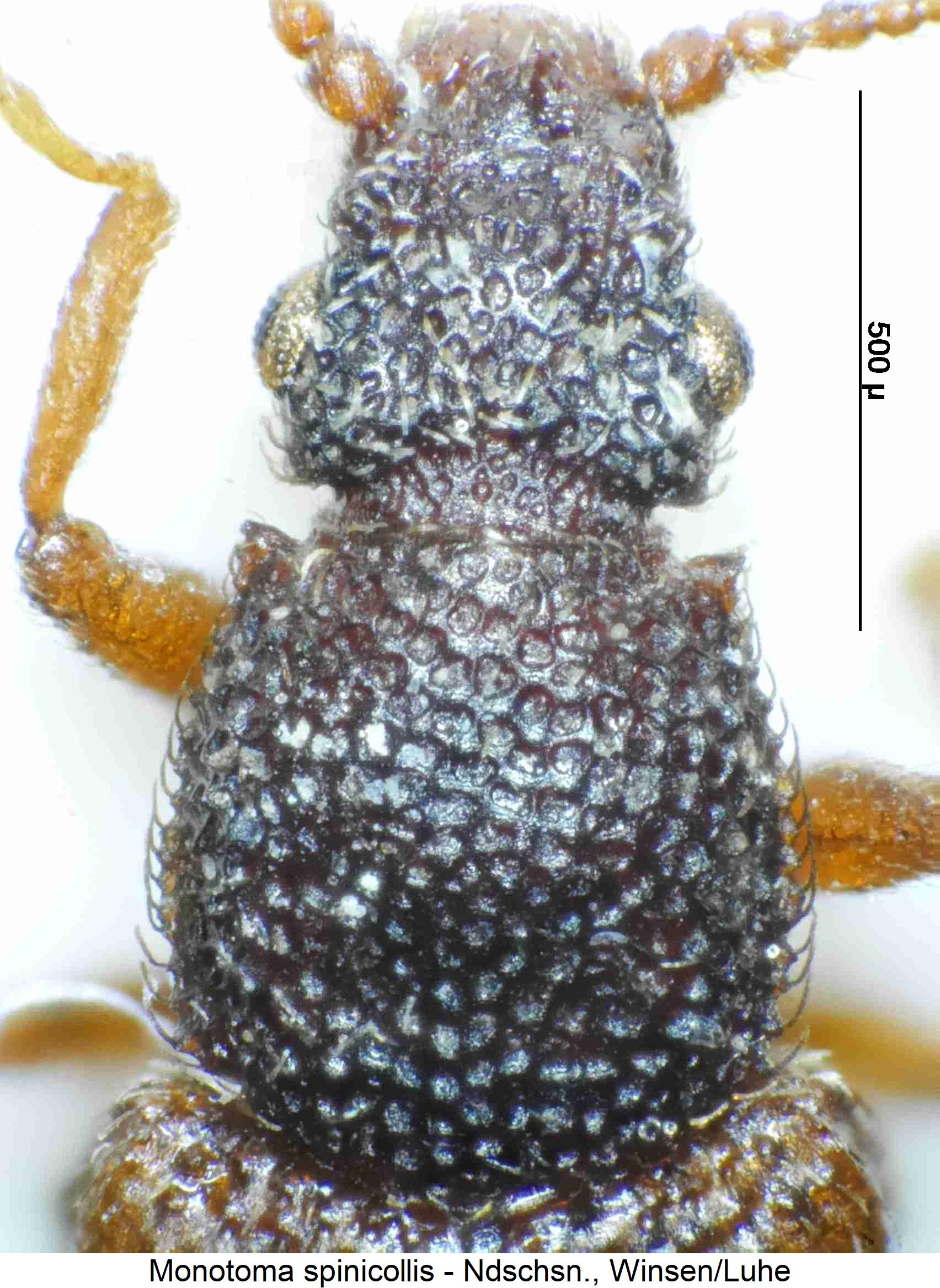
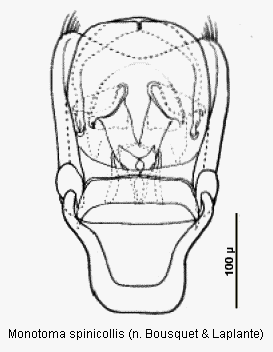
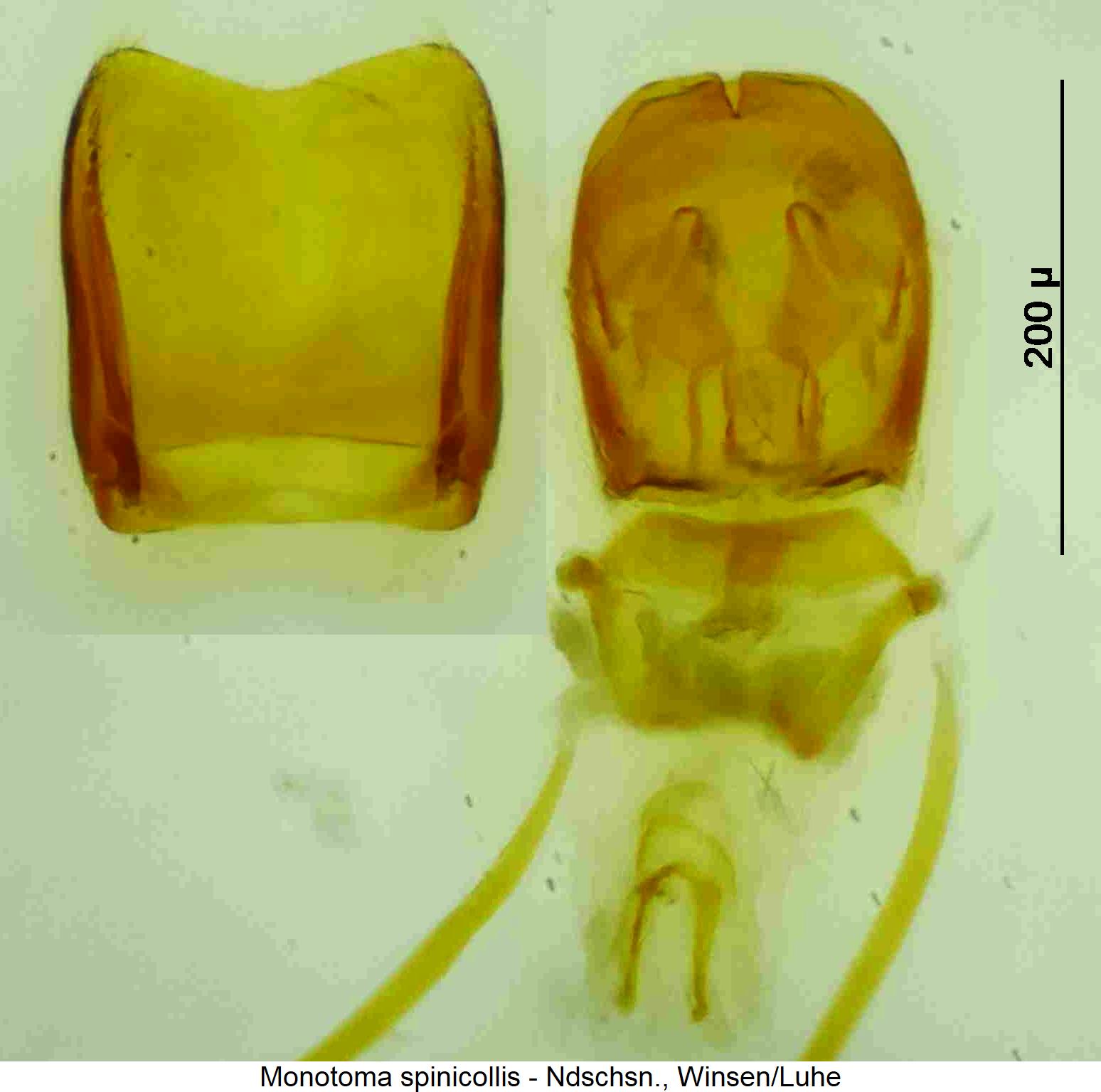
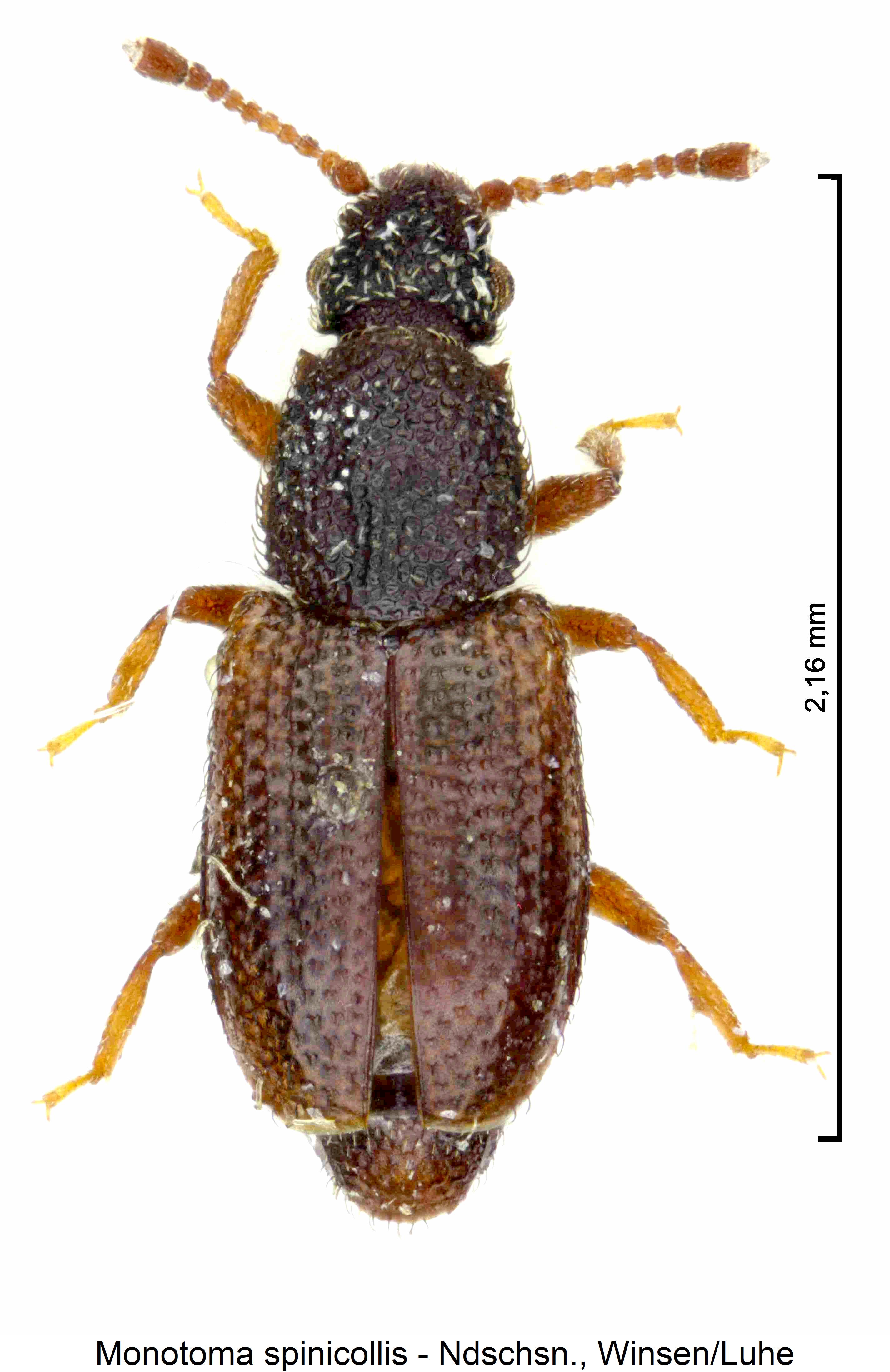
spinicollis Aubé, 1837🗺Pronotum with anterior angles usually projected latero-anteriorly [Abb. 12][Abb. 13]. Aedeagus as in [Abb. 14][Abb. 15]. 2.0-2.3 mm. Habitus [Abb. 16]. Bousquet & Laplante have seen specimens from England, France, Dalmatia, Greece,Morocco and from the United States (Massachusetts) and a single specimen from Canada.
Abb. 12Abb. 13Abb. 14Abb. 15Abb. 16
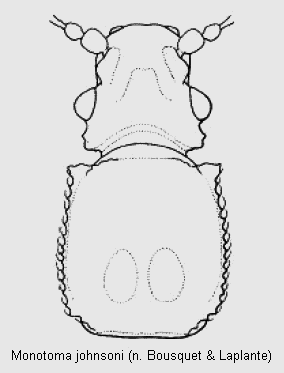
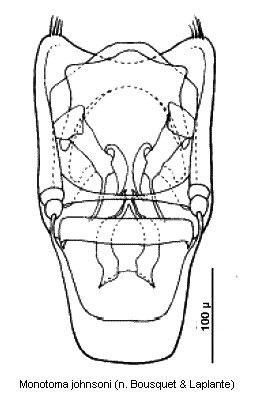
johnsoni Bousquet & Laplante, 1999🗺-Pronotum with anterior angles usually projected laterally [Abb. 17]. Aedeagus as in [Abb. 18]. The species is probably widely distributed to the world. Bousquet & Laplante have seen specimens from the New World, Europe, Africa, and Australia. The species has not yet been found in Canada but is included in this work because of the possibiliy that it occurs there.
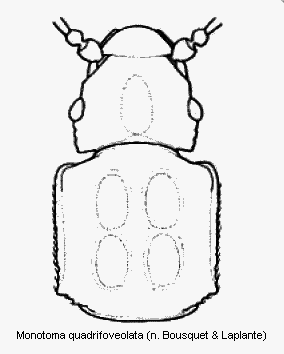
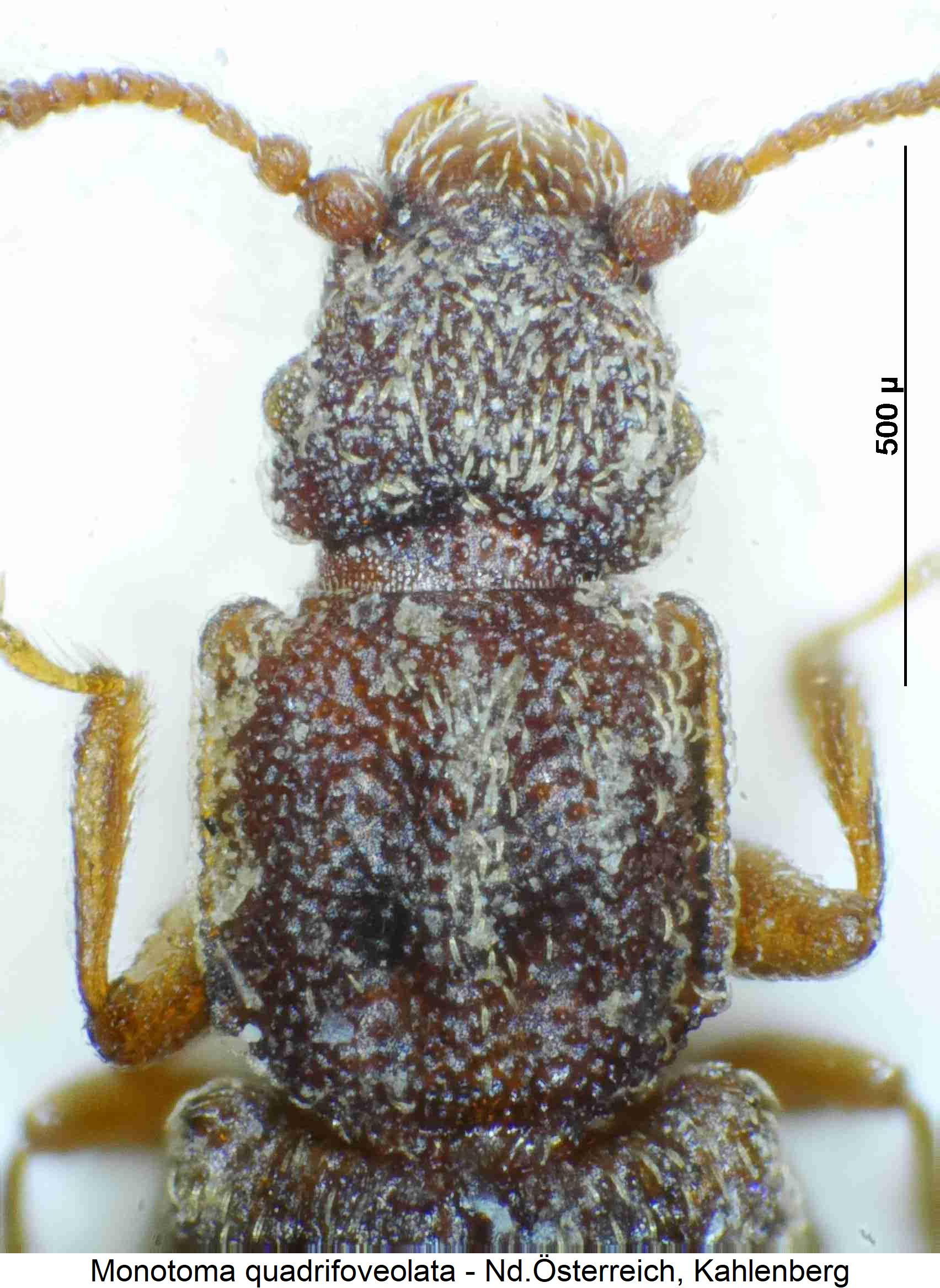
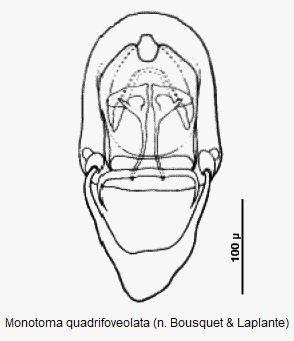
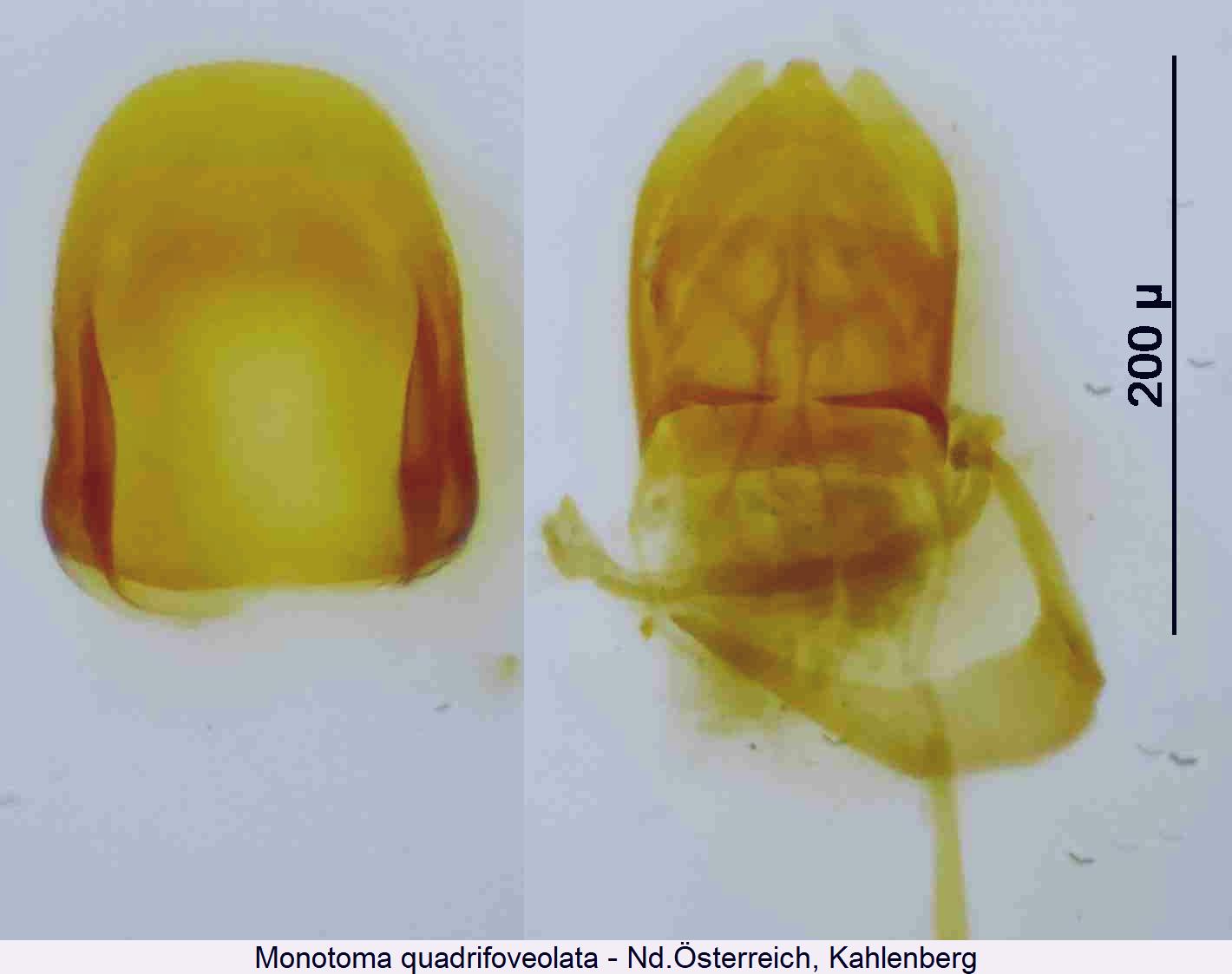
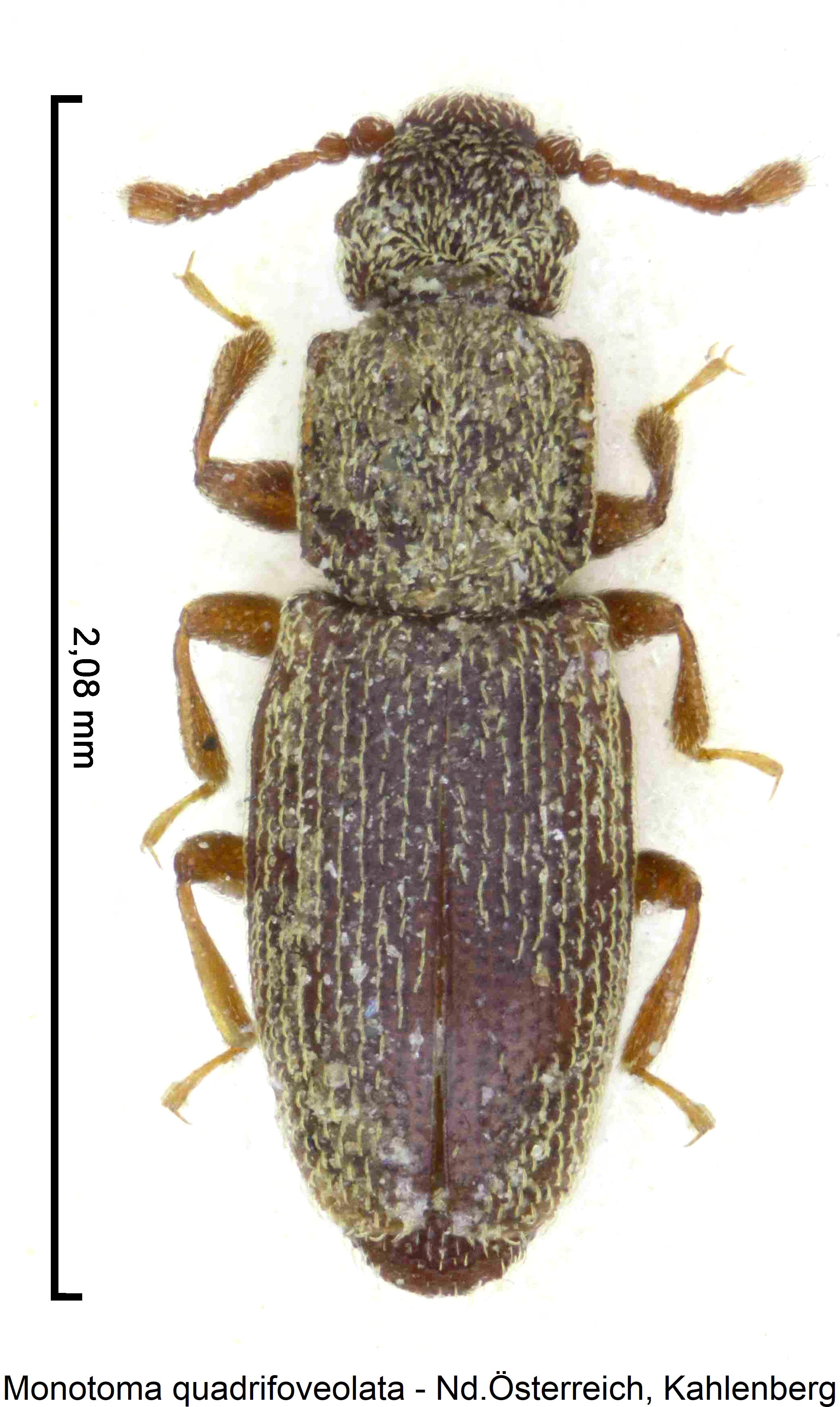
quadrifoveolata Aubé, 1837🗺Pronotal disc with 4 deep foveae, joined in pairs on each side to form 2 longitudinal furrows [Abb. 19][Abb. 20]. Aedeagus [Abb. 21][Abb. 22]. 1.9-2.3 mm. Habitus [Abb. 23]. This species has been reported from many countries around the world and is regarded as cosmopolitan.
Abb. 19Abb. 20Abb. 21Abb. 22Abb. 23
→ 6-Pronotal disc with 2, usually shallow, foveae in posterior half, rarely with 2 very shallow impressions in anterior half (not connected to basal foveae).
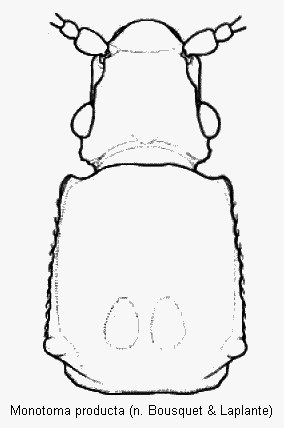
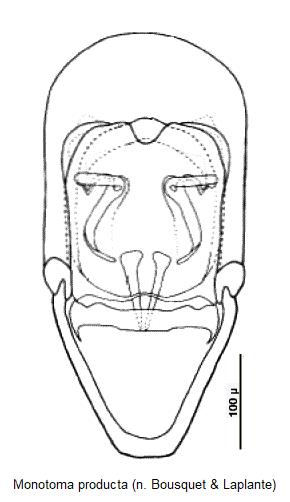
producta LecontePronotum elongate (ratio L/W usually > 1.18), with extremity of antetior angles blunt [Abb. 24]. Aedeagus [Abb. 25]. 2.5-3.2 mm. This species occurs along the Atlantic Coast, from New Brunswick to Florida.
Abb. 24Abb. 25
→ 7-Pronotum usually less elongate (ratio L/W < 1.15), with extremity of anterior angles rounded.
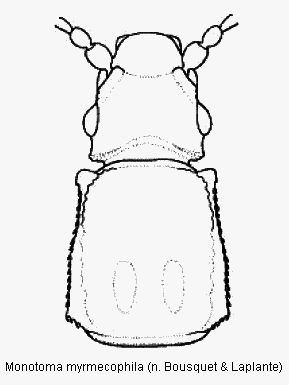
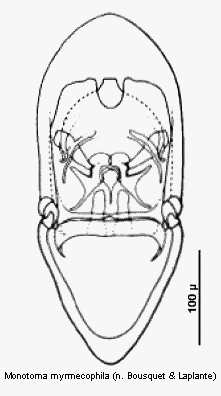
myrmecophila Bousquet & Laplante, 1999Setae on head and pronotum short, wide, more or less recumbent. Pronotum with sides divergent posteriorly [Abb. 6]. Antennomere 3 slightly shorter than antennomere 2. Aedeagus [Abb. 28]. 2.0-2.7 mm. This species occurs from Michigan to Alberta, south to Colorado. It is known in Canada from two localities In manitoba and Alberta.
Abb. 6Abb. 28
→ 9-Setae on head and pronotum elongate, narrow, suberect. Pronotum with sides more or less parallel to slightly rounded posteriorly [Abb. 26][Abb. 5]. Antennomere 3 as long as antennomere 2.
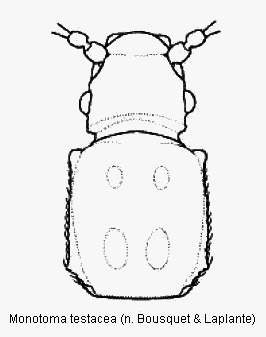
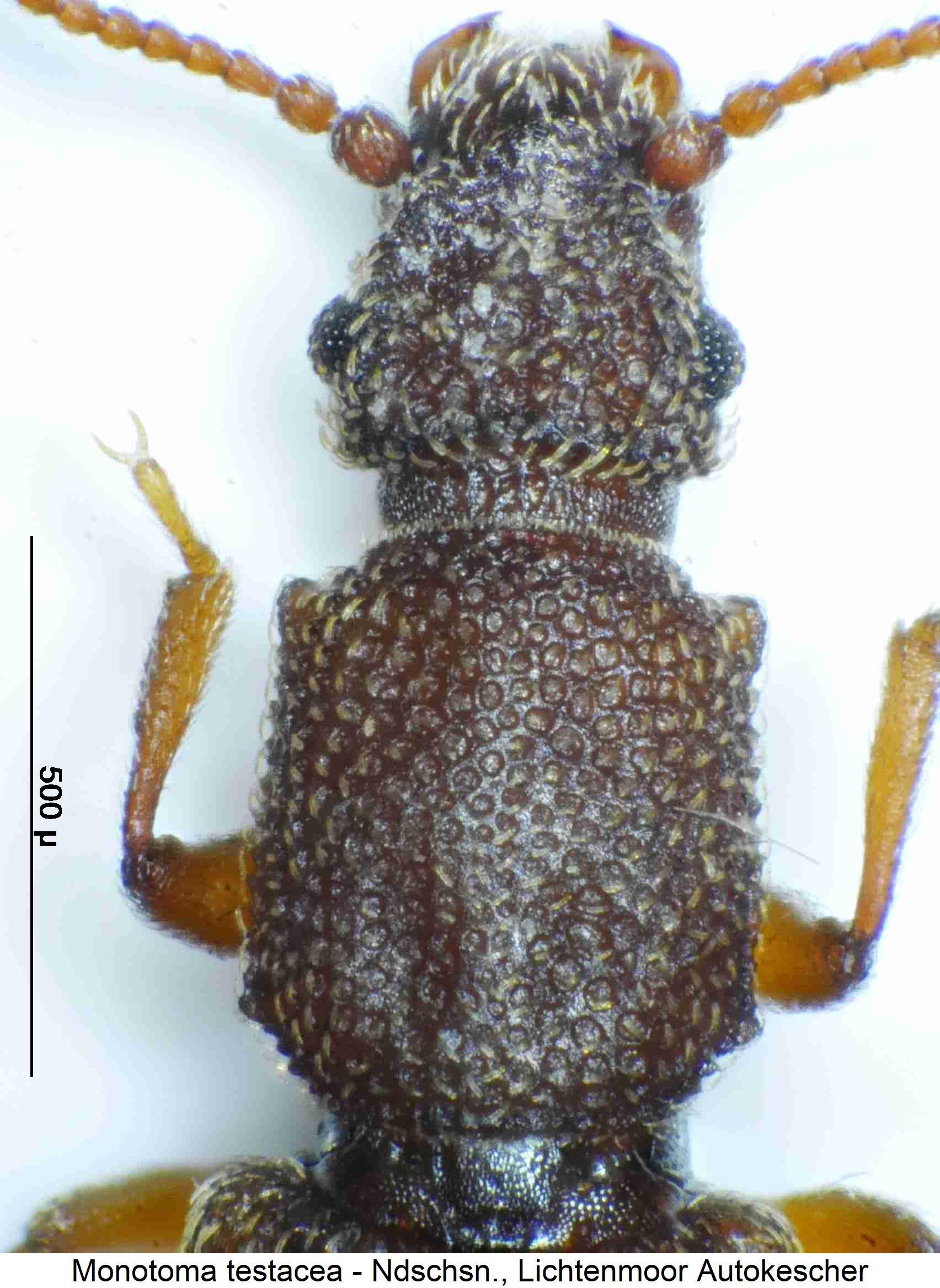
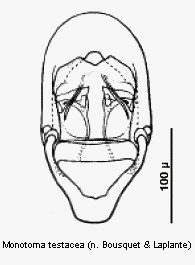
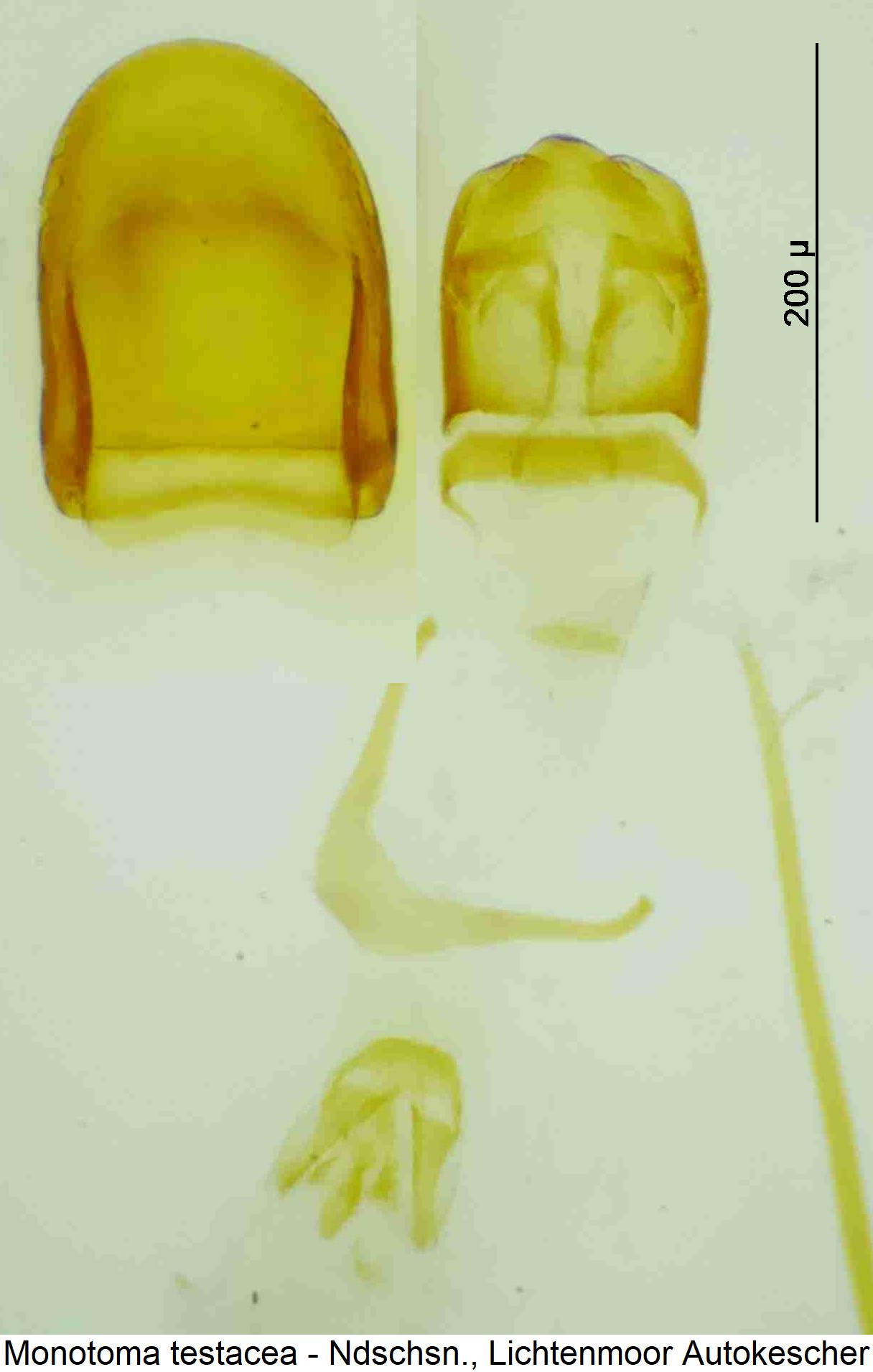
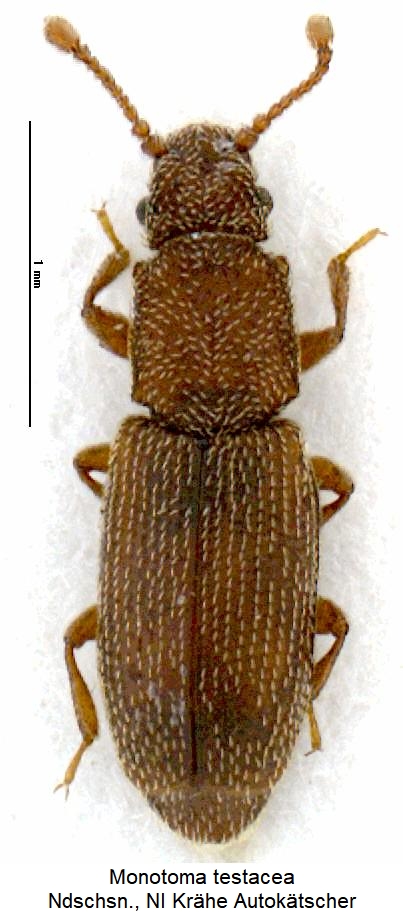
testacea Motsch., 1845🗺Body dorsally more or less uniformly reddish. Pronotum with sides slightly sinuate to parallel, anterior angles slightly protruding [Abb. 26][Abb. 29]; disc rather flat, with 2 more or less distinct impressions on anterior half. Aedeagus [Abb. 30][Abb. 31]. 1.8-2.2 mm. Habitus [Abb. 32]. This species has been recorded from various European countries, Caucasus, Turkistan, Siberia, New Zealand and North America.
Abb. 26Abb. 29Abb. 30Abb. 31Abb. 32
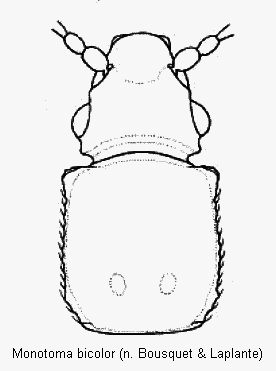
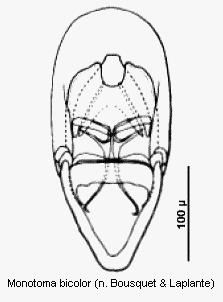
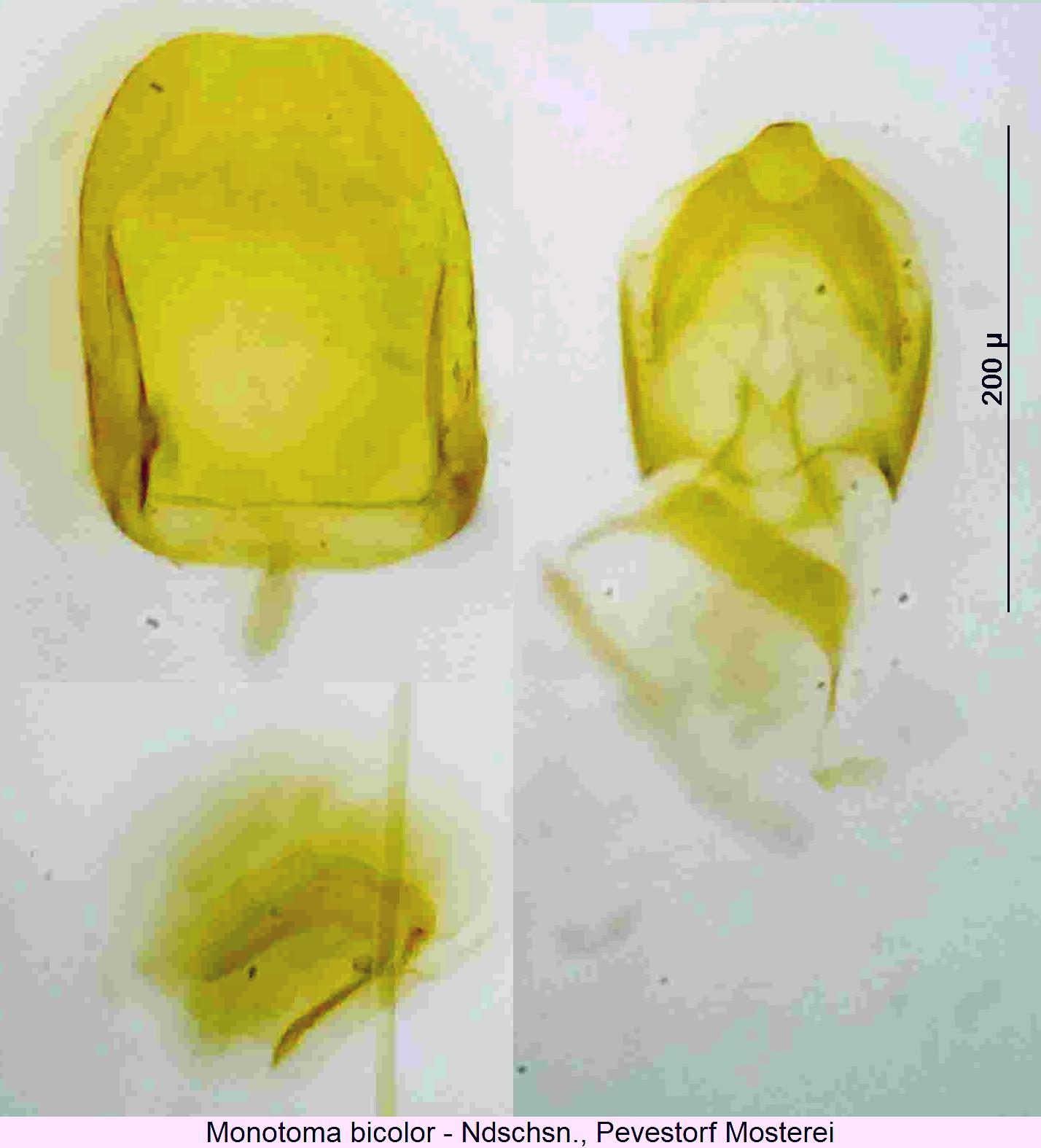
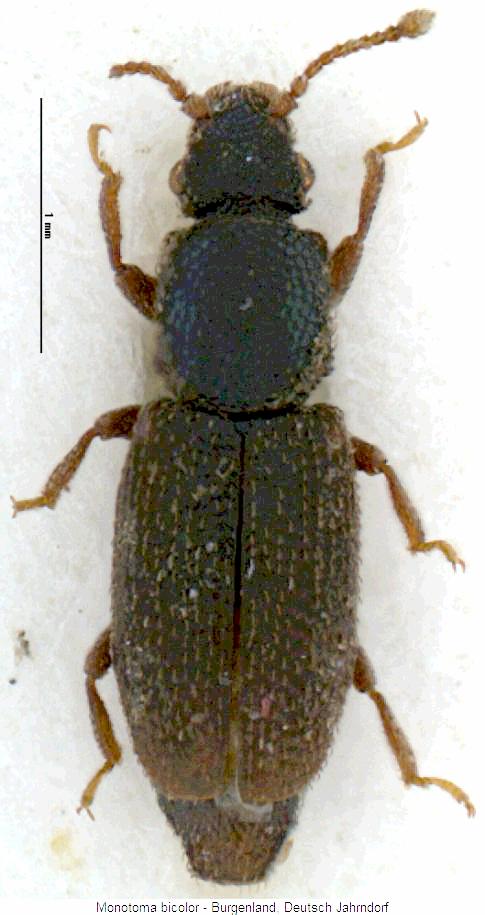
bicolor Villa, 1835🗺-Head and pronotum reddish brown to piceous, distinctly darker than elytra. Pronotum with sides usually rounded. Anterior angles more protruding [Abb. 5]; disc rather convex without impressions on anterior half. Aedeagus [Abb. 33][Abb. 34]. 1.9-2.5 mm. Habitus [Abb. 35]. This species has been recorded from various countries in Europe, North Africa, Caucasus, Syria, Siberia, New Zealand and North America.
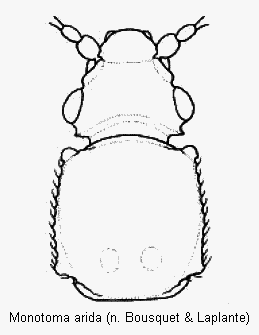
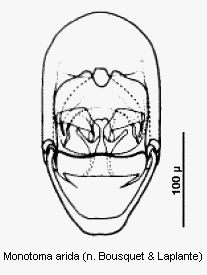
arida CaseyLast visible abdominal sternite with large median, oval, finely granulate depression. Pronotum slightly elongate (1.10-1.15 times as Iong as wide) [Abb. 36]. Aedeagus [Abb. 37]. 1.8- 2.2 mm. North America.
Abb. 36Abb. 37
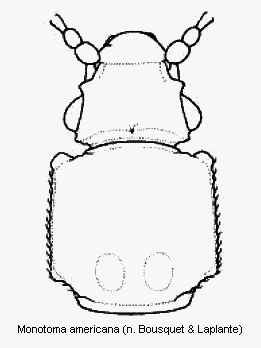
→ 12-Last visible abdominal sternite at most with small, shallow, relatively smooth depression. Pronotum subquadrate (1.00-1.07 times as long as wide) [Abb. 27].
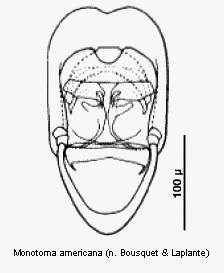
americana Aubé, 1837🗺Tegmen shallowly notched at apex [Abb. 38]. 1.9-2.4 mm. North America. Introduced to Italy, Croatia.
Abb. 38
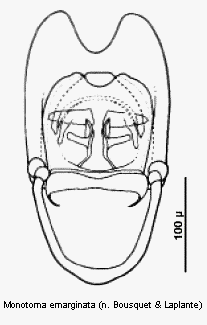
emarginata Bousquet & Laplante, 1999-Tegmen markedly notched at apex [Abb. 39]. Size as americana. This species lives in eastern North America from Ontario south to Florida and Texas. It is known in Canada from one locality in Ontario.
Posterior margin of head with small, hornlike, median projection [Abb. 27]. Last visible abdominal sterite smooth. See americana LZ >>>12
Abb. 27
-Posterior margin of head without median projection. Last visible abdominal sternite with small protuberance in most specimens. See emarginata LZ >>>12
 🗺
🗺 Pronotum distinctly wider anteriorly [Abb. 1]. Pronotum with small shallow punctures, irregularly spaced, not contiguous [Abb. 2]. Aedeagus [Abb. 3]. 1.4-1.9 mm. Habitus [Abb. 4]. Europe, Caucasus, Japan, West Africa, Australia, New Zealand and America. The species has been accidentally introduced in North Anterica.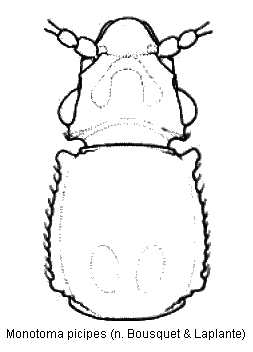



 Käfer Europas herausgegeben von Arved Lompe sind lizenziert unter den Bedingungen der Creative Commons International 4.0 Lizenz BY-SA (Namensnennung-Weitergabe unter gleichen Bedingungen)